
In the Indian Premier League, teams often finish the league stage with the same number of points. When this happens, the ranking on the IPL 2026 Points Table is determined by Net Run Rate, commonly known as NRR.
NRR measures how quickly a team scores runs compared to how quickly they concede runs. It acts as a tie-breaker when teams have equal points. This means that even a single big win or heavy defeat can influence playoff qualification.
The basic idea behind Net Run Rate
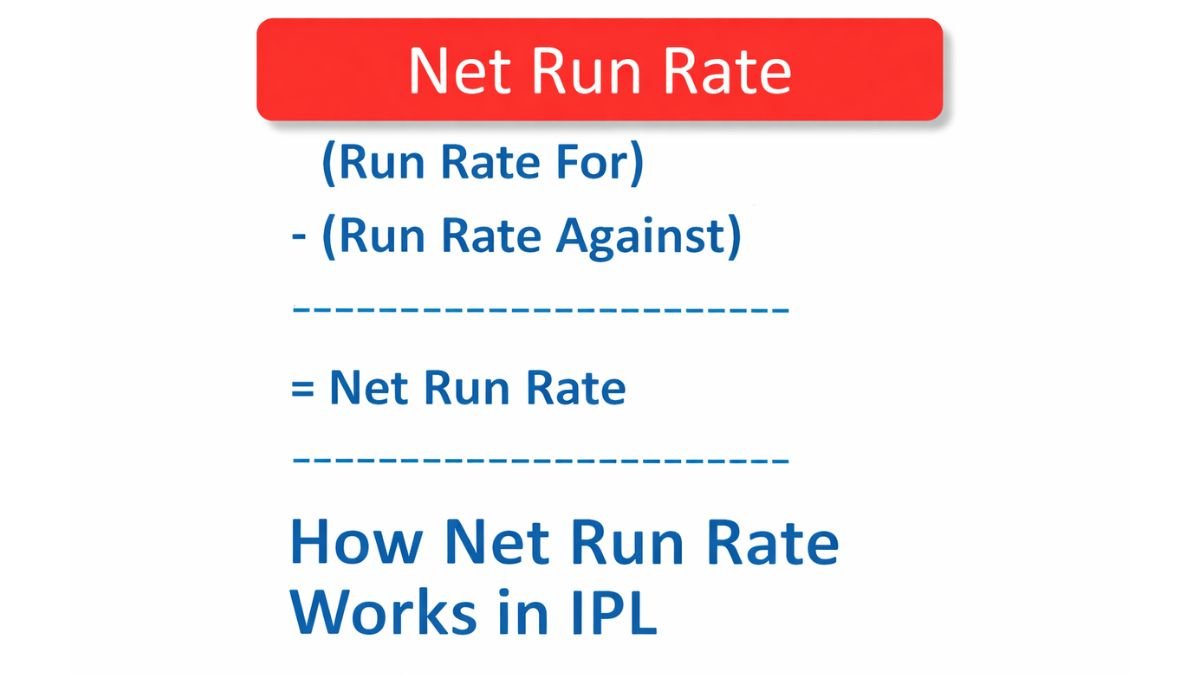
Net Run Rate is calculated using a simple formula:
NRR = (Average runs scored per over) – (Average runs conceded per over)
In simpler terms:
- How fast your team scores runs
- Minus how fast opponents score against you
If a team scores faster than their opponents across matches, their NRR becomes positive. If opponents score faster, the NRR becomes negative. Over a full season, this number can become a decisive factor in league standings.
Example of how NRR is calculated
Consider this example:
Team A
- Scores 180 runs in 20 overs
- Opponent scores 160 runs in 20 overs
Run rate scored = 180 ÷ 20 = 9.0
Run rate conceded = 160 ÷ 20 = 8.0
Net Run Rate = +1.00
This means Team A performed better in scoring speed compared to the opposition. Now imagine this across multiple matches. Every run scored and conceded contributes to the overall NRR.
Why teams care about NRR during the season
During the league stage, teams constantly monitor their NRR because it can determine who reaches the playoffs. For example, two teams might both have 16 points, but the team with the higher NRR will finish higher on the table.
This is why teams sometimes:
- Try to win matches quickly when chasing
- Try to restrict opponents to low totals
- Aim for big victory margins
These strategies directly influence their position on the IPL 2026 Points Table.
Famous IPL seasons decided by NRR
Several IPL seasons have seen dramatic finishes where Net Run Rate determined playoff qualification. In some cases, teams with equal points were separated by extremely small NRR differences. A single boundary or a slower run chase could change the standings. Because of this, commentators often discuss NRR scenarios during the final weeks of the tournament.
How NRR affects strategy in the final matches
Toward the end of the league stage, teams often calculate the required margin of victory to improve their NRR.
For example:
- A team chasing 160 might aim to finish the chase in 16 overs instead of 20.
- A bowling team might push harder to bowl out the opposition early.
These tactical decisions are influenced by the upcoming fixtures in the IPL 2026 Schedule.
Why NRR will remain crucial in IPL 2026
With ten teams competing in the tournament, the race for playoff spots becomes extremely competitive. It is common for several teams to finish the season with the same number of points. When that happens, Net Run Rate becomes the deciding factor. That is why every run scored and every run conceded matters throughout the season.In a tournament as competitive as IPL 2026, NRR can quietly determine which teams move forward and which teams are eliminated.

2 thoughts on “How Net Run Rate Works in IPL and Why It Matters”