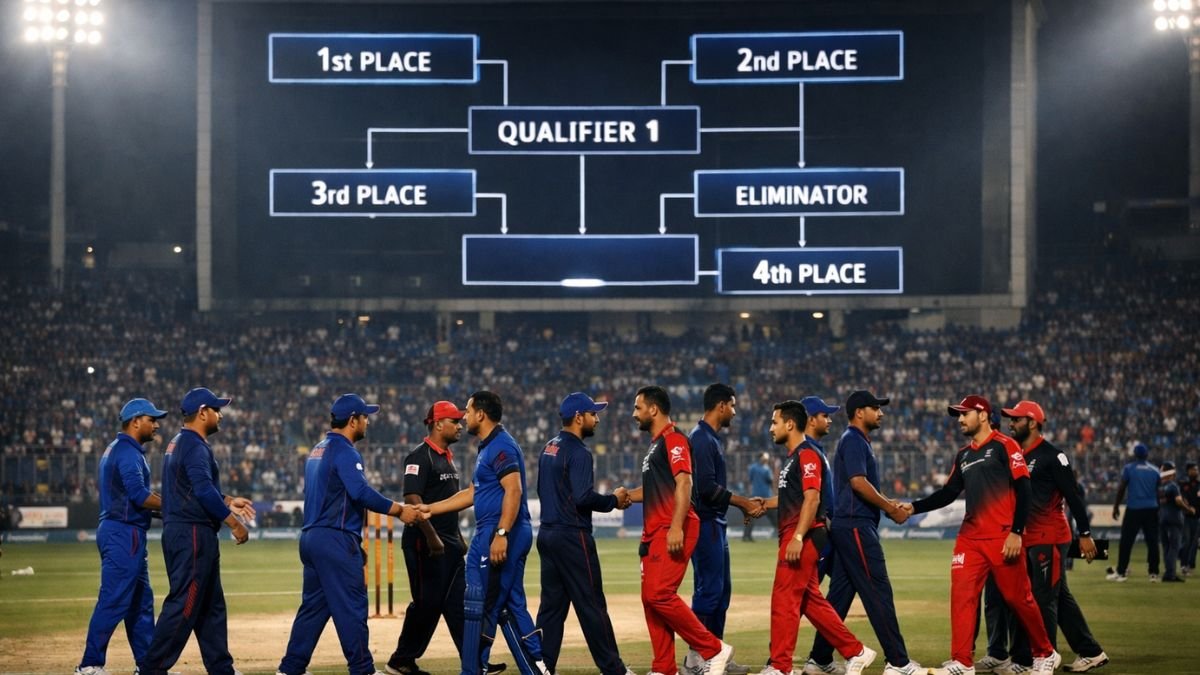

At first glance, the IPL playoff system appears simple: finish in the top four and compete for the trophy. But the format is deliberately structured to reward consistency across the league stage. Finishing in the top two provides a decisive advantage that often shapes the championship race even before knockout matches begin.
Understanding how the playoff structure works is essential when tracking the IPL 2026 Points Table, especially during tight qualification battles late in the season.
The four-team playoff structure explained
The IPL uses a Page Playoff system, which differs from a straight semifinal format. Here’s how it works:
- Qualifier 1: 1st vs 2nd
- Eliminator: 3rd vs 4th
- Qualifier 2: Loser of Qualifier 1 vs Winner of Eliminator
- Final: Winner of Qualifier 1 vs Winner of Qualifier 2
This structure means the top two teams get two opportunities to reach the final. Even if they lose their first playoff match, they still have another chance. Teams finishing third or fourth do not receive that safety net. A single defeat eliminates them.
Why the top-two finish offers a massive edge
The advantage of finishing in the top two lies in margin for error. In high-pressure knockout cricket, even dominant teams can have an off day. The playoff format acknowledges league consistency by offering an additional pathway to the final.
Historically, teams finishing first or second have won a significant share of IPL titles. That pattern underscores how crucial sustained performance across the league stage can be.
As fans follow the IPL 2026 Schedule, late-season fixtures often become critical not just for qualification, but for securing a top-two berth rather than settling for third or fourth.
How Net Run Rate influences qualification
Points determine primary standings, but when teams finish level, Net Run Rate (NRR) becomes the separator. This is where aggressive victories and damage control in defeats matter.
A team may technically secure enough wins to qualify, yet miss the top-two advantage due to inferior NRR. This dynamic creates strategic tension in final league matches, where teams aim not only to win but to improve their position on the IPL 2026 Points Table.
Psychological impact of playoff positioning
Beyond structural advantage, playoff seeding influences mindset. Teams finishing first or second enter knockouts with momentum and confidence. They have often dominated the league stage and built tactical clarity.
By contrast, teams scraping into third or fourth may carry pressure from late qualification battles. With no second chance available, risk tolerance decreases, and strategies can become conservative. Captains across IPL 2026 Teams often emphasise finishing in the top two as a primary objective even before thinking about the final.
Why the format rewards long-term consistency
The IPL’s playoff system is designed to prevent short bursts of late-season form from overshadowing sustained excellence. By giving top-two teams two shots at qualification, the league reinforces the importance of performance over fourteen league matches. This design keeps the league stage competitive until the final rounds, as teams chase not just survival but positional advantage.
Why this structure still shapes IPL 2026
As IPL 2026 unfolds, the playoff framework will once again define strategic priorities. Teams are not merely targeting qualification — they are calculating how to maximise safety through seeding.
In a tournament defined by narrow margins, understanding how the playoff ladder works changes how fans interpret standings, tactics, and late-season intensity. Because in the IPL, where you finish can matter just as much as whether you qualify.
