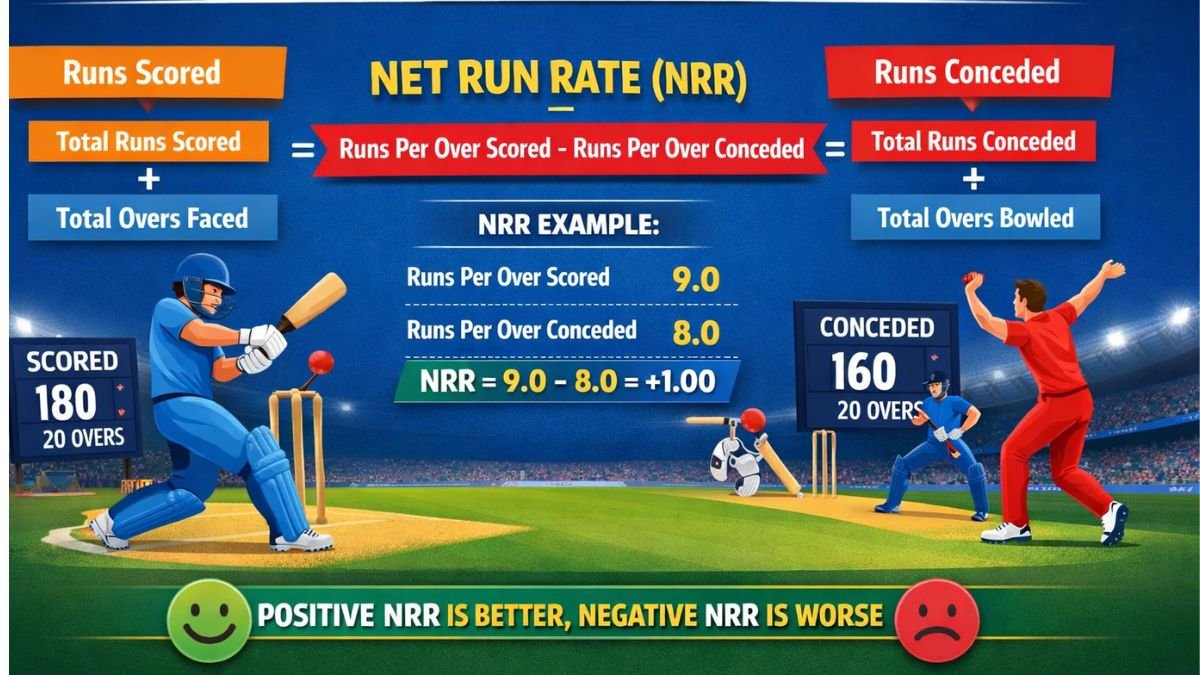

In the IPL, league standings often look simple — wins bring two points, losses bring none. But when teams finish level on points, the real separator emerges: Net Run Rate (NRR). This number frequently determines which teams advance to the playoffs and which narrowly miss out.
Understanding how Net Run Rate works is essential for anyone following the IPL 2026 Points Table, especially during tight qualification battles.
What Net Run Rate actually measures
Net Run Rate is not just about scoring fast. It measures the difference between:
- A team’s average runs scored per over
- And the average runs conceded per over
The formula looks like this:
NRR = (Total runs scored ÷ Total overs faced) – (Total runs conceded ÷ Total overs bowled)
It reflects overall dominance across matches not just wins, but how convincingly those wins were achieved.
For example:
- A team winning by large margins boosts its NRR.
- A team losing heavily sees its NRR drop sharply.
- Narrow victories may earn points but barely move NRR.
This is why teams sometimes chase targets aggressively even after securing qualification to strengthen their position in the standings.
Why teams tied on points depend on NRR
In IPL history, multiple seasons have seen playoff spots decided by decimals. When two or more teams finish with equal points, ranking is determined by:
- Points
- Net Run Rate
- Head-to-head (if applicable under regulations)
Because of this structure, even a single heavy defeat can undo weeks of solid performances.
As fans track the IPL 2026 Schedule, late-stage matches often carry dual pressure: winning the game and protecting NRR. Teams don’t just aim to win they aim to win big.
The strategic impact of Net Run Rate
NRR influences tactical decisions more than many realise.
Captains may:
- Promote aggressive batters higher up the order
- Delay slowing down even after crossing a safe target
- Avoid batting collapses to prevent NRR damage
Bowling captains, meanwhile, attempt to:
- Restrict opponents below par totals
- Close innings quickly
- Avoid conceding heavy overs at the death
This tactical layer affects how IPL 2026 Teams approach seemingly routine fixtures. A match against a lower-ranked side may become an opportunity to repair NRR damage from earlier losses.
Why fans often misunderstand NRR
A common misconception is that NRR resets every match. It does not. It accumulates across the entire league stage.
Another misunderstanding is that chasing in fewer overs guarantees a major boost. While quick chases help, the effect depends on the scale of victory relative to previous matches.
NRR is cumulative meaning:
- Early heavy losses can haunt teams later.
- Late dominant wins can dramatically reshape standings.
This cumulative effect makes the middle phase of the IPL season strategically crucial.
Why Net Run Rate still shapes IPL 2026
As competition intensifies, margins grow thinner. The IPL’s structure, with ten teams fighting for four playoff spots, ensures qualification battles often go down to final league games.
In such scenarios, NRR becomes the invisible force shaping playoff destinies.
It influences:
- Match approach
- Batting tempo
- Bowling discipline
- Selection strategy
